Who Walks Down the Aisle First? The Ultimate Guide to Wedding Processionals
Learn who walks down the aisle first in 2025. From traditional religious orders to modern LGBTQ+ and secular trends, master your wedding processional today.
- Modern couples are increasingly prioritizing personal choice over strict tradition.
- The processional sets the tone for the entire ceremony experience.
- Rehearsals are non-negotiable for timing and musical cues.
Determining who walks down the aisle first is much more than a logistical box to check on your wedding planning list. It is the opening beat of your ceremony, a choreographed sequence that tells the story of your families, your friendships, and ultimately, your union. As a public speaking coach, I often tell my clients that the processional is the "prelude to the promise." It builds the emotional momentum that carries you all the way to the "I do."
While tradition offers a clear roadmap, the landscape of 2025 and 2026 weddings shows a massive shift toward personalization. Whether you are following a strict religious liturgy or rewriting the rules for a secular celebration, the order in which your wedding party enters defines the energy of the room.
The Traditional Roadmaps: Cultural and Religious Variations
Historically, the order of the processional was dictated by religious custom and social etiquette. If you are planning a ceremony within a specific faith, these guidelines serve as your baseline. However, even these "rules" are seeing subtle shifts as couples look to honor their heritage while reflecting their modern values.
The Western Christian Tradition
In most Christian ceremonies, the processional follows a hierarchical structure that culminates in the bride's entrance. Usually, the groom is already at the altar, having entered from a side door with the officiant.
| Role | Traditional Order |
|---|---|
| Officiant | Enters from the side or leads the line |
| Grandparents | Seated first to honor the family legacy |
| Parents of the Groom | Escorted to their seats |
| Mother of the Bride | The final guest seated before the formal party |
| Groom | Enters from the side or walks the Mother of the Bride |
| Wedding Party | Pairs of bridesmaids and groomsmen |
| Maid of Honor | Walks solo or with the Best Man |
| Flower Girl/Ring Bearer | The final "cute" moment before the reveal |
| Bride & Father | The grand entrance |
For more specific guidance on these ceremonies, you might find our Christian Wedding Ceremony Script or Catholic Wedding Ceremony Script helpful for mapping out your specific timeline.
The Jewish Tradition: A Family Affair
The Jewish processional is notably different because it involves the entire family in a way that many modern secular couples are now adopting. In this tradition, both the groom and the bride are escorted by both parents, symbolizing the joining of two family units rather than the "giving away" of one person.
Note
Secular and Modern Secular Orders
For non-religious ceremonies, the rules are much more flexible. Often, the officiant will lead the way to signal the start of the ceremony. The groom often chooses to walk down the aisle rather than waiting at the front, a choice that acknowledges his equal participation in the journey to the altar.
The Modern Shift: Why Couples are Rewriting the Rules
Many couples today actively reject traditional wedding "rules" in favor of personalized choices. This shift isn't just about being different; it’s about agency and representation.
The Rise of the Solo Walk
A growing number of brides now choose to walk down the aisle alone. This is a powerful statement of independence. As a professional vow writer, I’ve seen this choice gain traction among older brides, those who have been married before, or those who simply feel that the symbolism of being "handed over" doesn't align with their worldview.
Shared Escorts and Diverse Roles
We are seeing a rise in "Dual Parent Escorts." While traditionally rooted in Jewish culture, many brides in secular weddings are now accompanied by both parents. Others walk with their mother only, and some choose a sibling, a child, or a close friend.
Tip
LGBTQ+ Processionals
In LGBTQ+ weddings, there is no set "standard," which has led to some of the most creative and moving processionals in recent years. Common approaches include:
- The Simultaneous Entrance: Using two aisles to walk down at the same time, meeting at the altar.
- Hand-in-Hand: Walking down the aisle together to symbolize entering the marriage as equal partners from the start.
- The Coin Toss: A playful way to decide who goes first if both partners want a traditional "entrance" moment.
2025–2026 Trends: Curvature, Meadows, and Connections
The wedding industry is moving toward "immersive experiences." This affects not just what people wear, but how they move through the space.
The "Meadowcore" Narrative
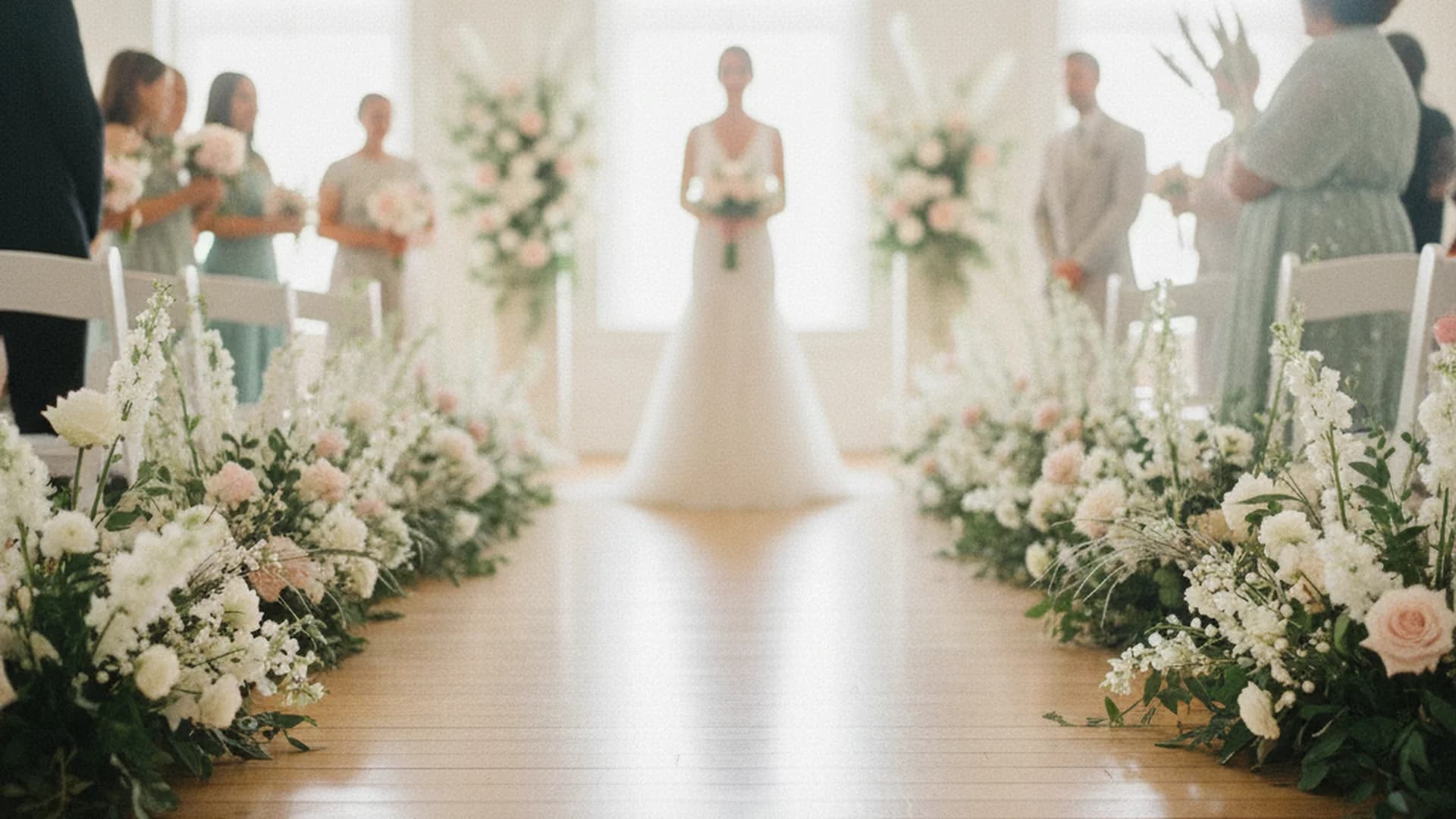
Aisles are being replaced by "meadows"—low-lying floral installations that curve and flow. Instead of a rigid straight line, the wedding party walks through what looks like a natural field. This trend emphasizes a softer, more organic feel and often dictates a slower, more intentional pace of walking.
Circular Seating and Serpentine Aisles
Moving away from the "two sides" layout, 2026 trends feature "ceremony in the round" or "S-shaped" aisles. This allows guests to see the couple from multiple angles. When deciding who walks down the aisle first in a circular layout, the timing is crucial, as the "walk" is often longer and more visible to every guest.
The "Deconstructed" Processional
A rising 2025 trend is the "Morning-Of Connection." Some couples are ditching the "big reveal" entirely. They eat breakfast together, get ready in the same suite, and enter the ceremony space hand-in-hand. This removes the performance aspect of the processional and focuses purely on the partnership.
Do this
From the OurVows workspace
Shaping your ceremony?
Draft your vows and ceremony, then keep the whole day organized in one place.
Best Practices and Expert Recommendations
As a public speaking coach, I focus on the "stagecraft" of the wedding. Here are the technical details that ensure your processional looks as good as it feels.
Aisle Width and Logistics
If you plan to walk with both parents, ensure your aisle is at least 5–6 feet wide. Standard aisles are often only 3–4 feet wide, which results in a cramped, awkward shuffle for three adults.
Heads up
The "Halfway Meet"
For a modern twist, have your escort walk you halfway, then walk the remaining distance alone. This symbolizes your transition from your family of origin into your new life. It’s a beautiful middle ground between honoring tradition and celebrating independence.
The Role of Pets
With many couples now incorporating pets, logistics become key. Always have a "handler" (a trusted guest or professional) who is responsible for the pet immediately after they reach the front. The dog should not be "walking" the bride; rather, a flower girl or groomsman should lead the pet.
For a broader look at ceremony planning, check out our Complete Guide to Wedding Ceremonies to see how the processional fits into the overall flow.
Common Mistakes to Avoid
Even the most well-planned weddings can hit a snag during the processional. Here are the most common errors I see:
- Walking Too Fast: Nerves cause a spike in cortisol, which naturally speeds up your heart rate and your pace. I advise my clients to "walk to the beat" of the music. Take slow, intentional steps.
- Skipping the Rehearsal: This is the #1 mistake. Without a physical walk-through, timing with music almost always fails. You don't want the bride reaching the altar before the song’s climax.
- Overcomplicating the Order: Having too many "special moments" (like stopping to hug every guest in the front row) can make the processional feel like a parade. It kills the emotional momentum.
- Looking Down: Many brides and grooms look at their feet to avoid tripping. This results in photos where you look sad or nervous. Keep your chin up and look at your partner.
- The "Right Side" Rule Confusion: Traditionally, the bride stands on the left. However, many forget that when walking, she should be on her father’s right arm. This allows him to "hand her off" to the groom without having to cross in front of her.
Frequently asked questions
Who walks the Mother of the Bride?
Does the groom walk down the aisle?
What if I have two fathers or two mothers?
How do we handle the music transitions?
Who walks first in a same-sex wedding?
Conclusion: Making the Walk Your Own
Whether you choose to follow the traditional path or create a "Meadowcore" serpentine entrance with your pet, remember that the processional is the first time your guests see you in the context of your marriage. It is a transition from "me" to "we."
Take your time, breathe through the nerves, and focus on the person waiting for you at the end of the aisle. The logistics of who walks down the aisle first are important, but the emotion behind those steps is what everyone will remember.
Do this
Ready when you are
Ready to Start?
Craft the perfect words to match your perfect entrance.
Ready when you are
Plan your wedding without the chaos.
Free forever for couples just getting started. Two minutes to set up. No credit card.
Keep reading
Crafting the Perfect Second Marriage Ceremony Script: A Guide to New Beginnings
Planning a remarriage? Discover how to write a Second Marriage Ceremony Script that honors your past while celebrating a beautiful, mature future.
Pew Decorations Wedding: 15 Inspiring Ideas and Trends for 2025-2026
Transform your ceremony aisle with stunning pew decorations wedding ideas. From sustainable florals to 2026 trends, learn how to frame your walk to the altar.
The Ultimate Wedding Processional Order Guide: Traditions and Modern Trends
Master your wedding processional order with our comprehensive guide. From traditional Christian and Jewish lineups to modern LGBTQ+ and 2025 trends.