Wedding Ring Exchange Wording: Examples to Use
By OurVows Editorial Team7 min readPublished Updated
On this page
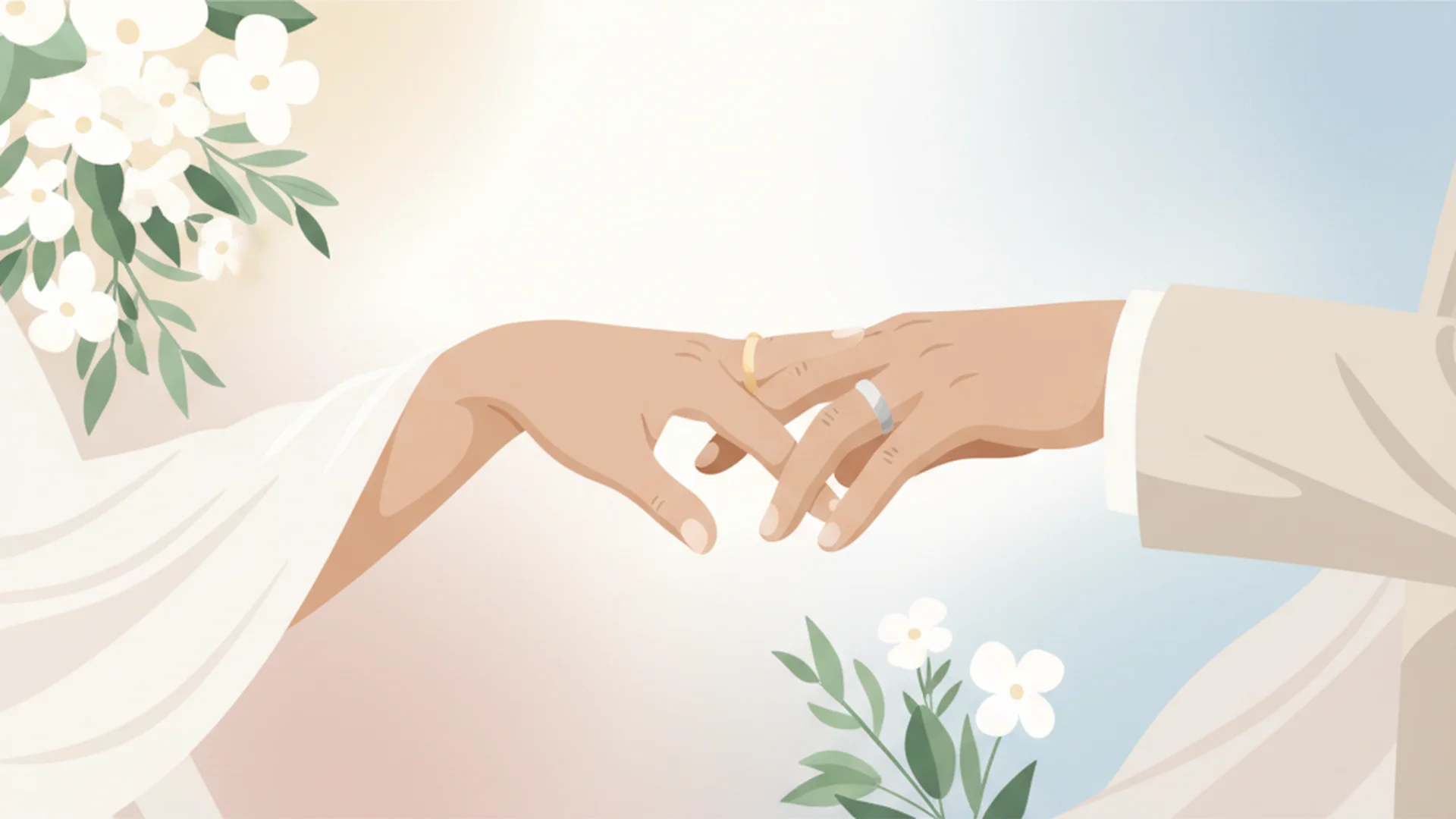
Ring exchange wording is the short statement each of you says as you place the ring on your partner's finger. Choose a line that is brief, easy to remember and true to you: a traditional "With this ring, I thee wed," a modern "I give you this ring as a sign that I choose you," or something playful. Below are examples in each style, ways to personalize them and tips for a smooth, no-fumble exchange.
While your vows are the promises you make for the future, the ring exchange is the "seal" on those promises, a moment where you act as well as speak.
A Short History of the Ring Exchange
Exchanging rings is an ancient custom. Many accounts trace it back to ancient Egypt and Rome, where the circle was a symbol of eternity, a shape with no beginning and no end. The fourth finger of the left hand is often linked to the Roman idea of a "vein of love" running straight to the heart. Anatomically that's a myth, but the tradition stuck in many Western ceremonies.
In many Western traditions, it's also a fairly recent habit for both partners to receive a ring. Today the exchange is generally a symbol of mutual commitment, and it fits into the broader ceremony described in our complete guide to wedding ceremonies.
Traditional Wedding Ring Exchange Wording
Traditional scripts are timeless for a reason. They carry a sense of gravity and history that many couples find comforting, particularly in religious or formal ceremonies.
Classic traditional script
"I give you this ring as a symbol of my love and faithfulness. With all that I am, and all that I have, I honor you. With this ring, I thee wed."
Faith-based wording
Wording differs between denominations and traditions, so ask your officiant or faith leader for the version they use. One common style is:
"In the name of the Father, the Son, and the Holy Spirit, I give you this ring as a sign of our marriage and my constant faith."
Modern and Minimalist Wording
Many couples prefer "less is more." Minimalist wording focuses on the choice you're making in the present moment, and it suits civil ceremonies and elopements where the atmosphere is more conversational.
The "I choose you" script
"I give you this ring as a sign that I choose you. To be my partner, my best friend, and my love, today and every day."
The "constant reminder" script
"Let this ring be a constant reminder of my promise to you, and a symbol of the life we are building together."
The "no end" script
"I place this ring on your finger as a symbol of our union. As these rings have no end, my love for you has no end. I am yours, and you are mine."
Humorous and Playful Ring Exchange Wording
If your relationship is built on laughter, you don't need to be solemn during the ring exchange. A touch of humor can ease the tension and make the moment feel like you.
Example 1: The real-life promise
"I give you this ring as a symbol of my love, and as a promise that I will still love you even when you're hangry or when you leave your socks on the floor."
Example 2: The team approach
"I give you this ring as a sign that we're on the same team. I promise to be your biggest fan, your best teammate, and to never spoil the ending of a show we're watching together."
Example 3: The season promise
"I promise to love you through every season of life, even football season. Wear this ring as a sign of my devotion."
Ways to Personalize the Exchange
You can make a short exchange feel more personal without making it long.
Keep the public words short and save the rest for later
If you've written long, emotional promises, you can share them in a private moment, such as a letter exchange before the ceremony, and keep the ring wording short and classic. That keeps the ceremony moving while preserving the intimacy of your deepest promises. Our guide to writing wedding vows can help with the longer version.
Ring warming
In a ring warming ritual, the rings are passed among guests before the exchange. The officiant might say:
"As these rings pass through your hands, we ask that you warm them with a silent prayer, a blessing or a well-wish for the couple's future."
It's a way to involve everyone in the ceremony, and it works best in smaller weddings.
Wording that reflects your values
Some couples reflect their values in the words themselves, for example by mentioning that their rings are recycled, or a one-of-a-kind design:
"This ring, unique in its design and crafted with care, represents our one-of-a-kind journey together."
Tips for a No-Fumble Exchange
Here is how to keep the exchange smooth.
The "repeat after me" method
We usually suggest the "repeat after me" style. It takes the pressure off memorizing lines during a high-adrenaline moment and lets you keep eye contact with your partner instead of reading from a card.
The "ring sticking" strategy
Fingers can swell with heat, nerves or stress. If the ring is tight, don't panic or force it. Say your words first while holding the ring at the tip of the finger, then slide it on calmly once you've finished speaking.
The "anchor" phrase
Every ring statement works best with an anchor phrase that carries the core meaning. Common anchors include:
- "I give you this ring as a symbol of my love."
- "With this ring, I thee wed."
- "Wear this as a sign of my commitment."
Common Mistakes to Avoid
Even well-planned ceremonies can hit a snag during the ring exchange. Here are some common ones.
Handing the real rings to a very small child or a pet
Giving valuable wedding bands to a young child or a pet is a risk. Consider using decoy rings for the walk down the aisle, and ask the best man or maid of honor to keep the real rings safe until the moment of the exchange.
Missing your cue
Starting to put on the ring the moment the officiant begins speaking can leave your photographer and videographer scrambling. Wait for your cue so they're ready to capture the close-up of your hands.
Wrestling with the knuckle
Trying to force a ring over the knuckle while reciting your words usually means a muffled voice and a strained expression. Pause your words, slide the ring on, then look up again to finish.
Assuming tradition is mandatory
Many couples feel they must use archaic phrasing such as "I thee wed." You don't. Rules about what must be said vary by location, so check your local marriage requirements and ask your officiant which words, if any, are required to make the marriage legal. A ring exchange itself is usually a custom rather than a legal requirement. If you're stuck for words, our wedding vow writer can help you find language that sounds like you.
Frequently Asked Questions
Who goes first during the ring exchange?
Traditionally the groom goes first, but modern couples can choose whatever feels most comfortable. Often the person who spoke their vows first leads the ring exchange too.
Is the ring exchange the same as the wedding vows?
No. Wedding vows are the broader, longer promises for the marriage. The ring exchange wording is a short statement about the physical symbol of the ring, and it acts as a "seal" on the vows.
How long should the ring exchange wording be?
Short. Think of it as an exclamation point to the ceremony rather than a second speech. You've already said your vows, and this part is about the symbol.
What if we aren't using rings?
That's fine. Some couples exchange watches, necklaces or other keepsakes. You can adapt the wording to "I give you this [item] as a symbol of my love," and the sentiment stays the same.
Can we include a reading during the exchange?
You can, but it's usually better to place readings before or after the exchange so the focus stays on giving the rings. For ideas, see our guide to wedding ceremony readings.
Vows, readings and the running order, together
Write privately, share the ceremony plan with your officiant when it's ready, and keep the whole day on one timeline. Plus is one payment that covers you both.