Interfaith Wedding Vows: Blending Traditions with Style and Soul
Navigate the complexities of writing interfaith wedding vows with our 2025 guide. Learn how to honor different religions while creating a modern, personal ceremony.
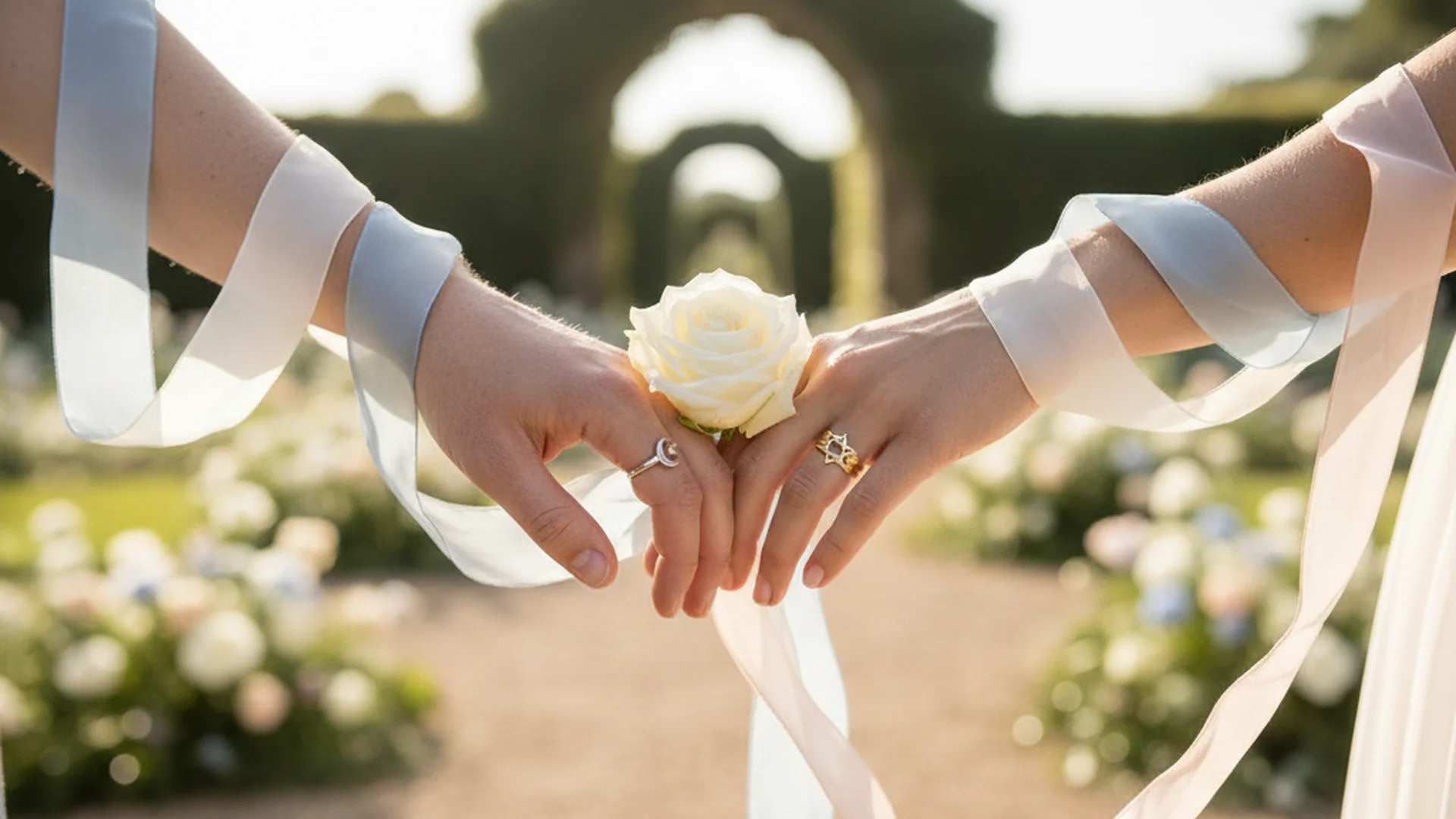
- A large and growing share of modern US marriages are interfaith, requiring new approaches to vows.
- Successful interfaith vows focus on "additive" elements rather than stripping away faith.
- Trends for 2026 emphasize fusion rituals and "Humanist-Plus" storytelling styles.
In the modern wedding landscape, the "merging of two families" is rarely a carbon copy of one another. Today, the altar is a beautiful collision of cultures, belief systems, and family expectations. Writing interfaith wedding vows is the ultimate creative challenge: you want to honor your grandmother’s traditional religious roots, respect your partner’s heritage, and somehow stay true to your own (perhaps slightly less dogmatic) identity.
The good news? You are not alone. A large and growing share of married adults in the U.S. now have a spouse with a different religious identity. We aren't just breaking traditions anymore; we are remixing them into something entirely new.
The Evolution of Interfaith Marriage (2025-2026)
The pattern tells a fascinating story of how we love today. In the Jewish community specifically, a substantial portion of currently married adults have a non-Jewish spouse—and among those married more recently, interfaith pairings have become the majority.
This shift has transformed the ceremony from a rigid ritual into a customizable experience. A growing number of couples now include a special custom related to their religion, race, or culture. This isn't about choosing one faith over the other; it’s about a "both/and" approach that celebrates the intersection of two journeys.
Note
Navigating the Religious "Must-Haves"
Before you put pen to paper, you need to understand the canonical landscape. Some traditions have specific "non-negotiables" that must be included for the marriage to be recognized within that faith.
Consulting Your Officiants
If you are having a co-officiated ceremony—for example, a Rabbi and a Priest or a secular celebrant and an Imam—you need to start the conversation at least six months out.
- Catholicism: Often requires specific language regarding the permanence of marriage and the upbringing of children. You can read more about these specific requirements in our guide to Catholic Wedding Vows.
- Hinduism: Focuses on the Saptapadi (Seven Steps) and shared duties. If you are blending this with Western traditions, check out our insights on Hindu Wedding Vows.
- Christianity: Usually centers on the covenant before God. For phrasing that bridges the gap, see our resource on Christian Wedding Vows.
Heads up
Step-by-Step Guide to Writing Your Vows
Writing interfaith wedding vows doesn’t have to feel like a diplomatic negotiation. Follow this three-step framework to find your voice.
1. The Reflection Phase
Sit down with your partner—separately at first—and answer these questions:
- What religious or cultural phrases feel "like home" to you?
- Are there specific terms (like Tikkun Olam or Namaste) that hold deep personal meaning?
- How do you feel about mentioning "God"? If one partner is secular, would "The Universe," "The Divine," or "This Community" feel more comfortable?
2. The Drafting Phase (The K.I.S.S. Method)
Expert officiants recommend the "Keep It Simple, Sweetheart" method. Your vows should ideally be 200–300 words. This ensures you have enough time to be meaningful (roughly 1–2 minutes) without losing your guests' attention.
| Element | Traditional Approach | Interfaith/Modern Approach |
|---|---|---|
| The Invocation | "In the presence of God..." | "In the presence of our families and the spirits of our ancestors..." |
| The Promise | "To follow the laws of [Religion]..." | "To honor the values of compassion and justice that we both share..." |
| The Closing | "As long as we both shall live." | "As we build a new tradition together, for all our days." |
3. The Edit Phase
Ensure your lengths are consistent. It is notoriously awkward if one partner delivers a five-page manifesto while the other offers a three-sentence "I promise to do the dishes." Aim for a similar word count to maintain emotional balance.
Tip
Real-World Examples of Interfaith Vow Blends
To help you visualize how this works, here are three examples of how couples are blending traditions in 2025.
Example 1: The "Humanist-Plus" Blend
Best for: A partner with a religious background and a secular/atheist partner.
"I stand here today before our community to take you as my partner. While I may not share the specific faith of your childhood, I promise to honor the traditions that made you the person I love. I promise to support your spiritual journey, to celebrate our holidays with a full heart, and to build a home founded on the universal values of kindness, patience, and Tikkun Olam—the shared duty to help heal the world."
Example 2: The Fusion Ritual Script
Best for: Incorporating physical symbols into the words.
"As we stand under this Mandap, I take these seven steps with you. Just as this unity candle represents the merging of our two families, my promises to you are a blend of our distinct histories. I promise to be the Christian 'helpmeet' you deserve and the partner who respects the Buddhist path of mindfulness. Together, we are not losing our identities, but expanding them."
Example 3: The "Storytelling" Vow
Best for: 2026 trends focusing on authenticity and humor.
"When we first met, I didn't think a Sunday-school teacher and a devoted nihilist could make it past the first date. But here we are. I promise to never make fun of your 'holy water' if you promise to never make fun of my 'healing crystals.' Most of all, I promise to keep our shared faith in each other as our primary North Star."
Do this
From the OurVows workspace
Writing your vows?
Get a heartfelt first draft to shape into your own words — then handle every other detail with OurVows.
2026 Trend Watch: What’s Next for Interfaith Ceremonies?
The upcoming wedding seasons are leaning heavily into "Additive" ceremonies. Instead of watering down both religions to a bland, secular middle ground, couples are choosing to include the "best of both worlds."
- Fusion Rituals: We are seeing more "breaking of the glass" while standing under a Hindu Mandap, or Buddhist Wedding Vows recited during a traditional Western ring exchange.
- Content Creator Integration: With the rise of "Wedding Content Creators," couples are opting for "raw," unpolished vows. This means less reading from a card and more eye contact, leading to shorter, punchier, and more emotional promises.
- Values over Dogma: 2026 is shifting toward "Humanist-Plus" vows—secular-led promises "sprinkled" with one or two key religious blessings to honor parents and heritage.
Common Mistakes to Avoid
Even with the best intentions, interfaith vow writing has its pitfalls.
- Mistake: TMI (Too Much Information). While you want to be personal, avoid inside jokes that exclude your religious family members or make the audience feel like they are intruding on a private therapy session.
- Mistake: The "11th Hour" Script. Stress is the enemy of sincerity. Experts recommend having your final draft ready two weeks before the ceremony.
- Misconception: "Interfaith means Secular." You don't have to strip the religion out to be "fair." In fact, the most beautiful vows often highlight the specific beauty of both traditions.
- Mistake: Forgetting the Audience. If you are using a language other than the one your guests speak (e.g., Hebrew, Sanskrit, Latin), always provide a translation in the program.
Tip
Frequently asked questions
Do we have to mention God in interfaith vows?
Can we have two officiants from different faiths?
What if our religions have conflicting vow requirements?
How do we handle "Call and Response" vs. Personal Vows?
Is it okay to use religious readings if the vows are secular?
Conclusion
At the end of the day, interfaith wedding vows aren't just about navigating two different sets of rules; they are about celebrating the fact that love is a universal language. Whether you are blending the solemnity of a cathedral with the vibrancy of a mandap or simply trying to find a middle ground between "God" and "The Universe," your vows are the foundation of your new life together.
The "faith" in interfaith is ultimately about the faith you have in each other to build a home where everyone is welcome.
Do this
Ready when you are
Ready to Start?
Use our AI-powered tool to craft the perfect blend of tradition and personality.
Ready when you are
Plan your wedding without the chaos.
Free forever for couples just getting started. Two minutes to set up. No credit card.
Keep reading

Writing the Perfect Wedding Vows for Your Soulmate: A 2025 Guide
Discover how to write heartfelt wedding vows for your soulmate. Explore 2025 trends, expert tips, and structures to express your unique bond perfectly.

Mastering the Wedding Vow Structure Template: A 2025 Guide
Struggling with writer's block? Use our expert wedding vow structure template to write personalized, meaningful vows for your 2025 or 2026 ceremony.

Wedding Vows for Older Couples: Crafting a Second Act Masterpiece
Discover how to write meaningful wedding vows for older couples. Explore 2025 trends, expert advice on blended families, and examples for a sophisticated ceremony.